// Synapse STEM Education · Est. 2016 · Orlando, FL
Why We
Built This
A decade serving Orlando families taught us one thing: great STEM education shouldn't stop at the classroom door. The Synapse Platform is our answer — and America's future demands it.
by 2030 · Deloitte
access to CS education
by Synapse since 2016
for U.S. STEM investment
01 · Our Origin
A Decade of Hands-On Evidence
What started as an afterschool center in Orlando became a decade-long research project — thousands of students, thousands of family conversations, and one recurring signal.
""How can we continue this level of structured learning at home?"
— Parents, consistently, 2016–2024
- 2016 Synapse Science & Technology Learning Center opens in Orlando — hands-on STEM afterschool for K–8.
- 2019 Digital Learning Kit (DLK) concept born — first prototype hardware kits sent home with students over summer break.
- 2022 Curriculum formalization — three grade-band tiers developed: LittleTechs, DigiKids, and Cadets.
- 2024 AI-DLK platform development begins — combining AI-powered lesson generation with subscription delivery and physical kit tiers.
- 2025 National launch preparation — Synapse Platform designed to scale from Orlando to families and homeschool communities nationwide.
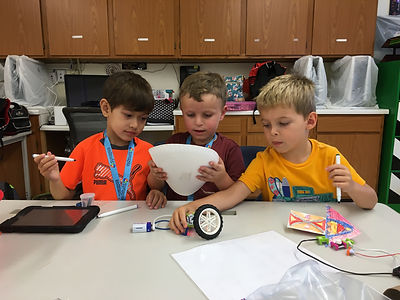
For ten years, Synapse Science & Technology Learning Center has been doing the work in Orlando — teaching kids to build circuits, program microcontrollers, design in 3D, and think like engineers. We've served over 2,500 students across every grade from Kindergarten through 8th.
The families we serve are not passive. They're engaged, ambitious parents who see STEM fluency as essential infrastructure for their children's futures — not an elective. When we watched students make breakthroughs in the lab, parents asked how to keep the momentum going at home.
The honest answer was: they couldn't — not at this level. Consumer apps were too shallow. Generic coding curricula skipped hardware entirely. And nothing combined IoT, microcontrollers, 3D design, and software in a single progressive K–8 pathway.
So we built it. Not from theory — from a decade of classroom data, parent feedback, and direct student outcomes. The Synapse Platform is the structured learning continuation that families asked for, rebuilt for national scale.
02 · The National Picture
America Has a STEM Gap.
We Have a Plan.
The data is unambiguous. The United States is producing a STEM crisis in slow motion — and K–8 is where the intervention window is widest and most cost-effective.
Policy tailwinds
The Nation is Mobilizing.
Synapse is Already Moving.
CHIPS & Science Act · 2022
Authorizes $280 billion in federal investment to reinforce U.S. technological leadership — including substantial allocations for STEM education pipelines at every level, with emphasis on building the future workforce from elementary school forward.
CSTA K–12 CS Standards
The Computer Science Teachers Association's national framework establishes that computational thinking, hardware literacy, and software development belong in every K–12 curriculum — the same disciplines at the core of the Synapse Platform's four content domains.
NSF STEM Education Programs
The National Science Foundation's Education and Human Resources division invests over $1 billion annually in programs designed to broaden participation in STEM — with a stated priority on K–8 foundational learning and underserved community access.
National STEM Education Strategic Plan
The five-year federal STEM strategy calls for every student to have access to high-quality STEM instruction, hands-on learning opportunities, and clear pathways connecting K–8 education to careers in engineering, computer science, and advanced manufacturing.
03 · Who This Serves
Built for Every Stakeholder
The urgency for STEM education reform resonates differently depending on where you stand — but the conclusion is the same.
"We want our child to have every advantage — but we don't always know how to give it to them at home."
Parents of K–8 students are increasingly aware that STEM fluency is not a future elective — it's present-tense currency. Yet most families lack a structured, progressive pathway to build those skills at home.
Designed from thousands of real parent conversations, the platform gives families a grade-appropriate, hands-on learning system that scales from Kindergarten through 8th grade — without requiring parents to be engineers themselves.
- ✓ Structured progression — not a collection of random projects. Each lesson builds on the last, aligned to CSTA and NGSS standards.
- ✓ AI-powered personalization — the platform adapts to each student's pace, grade band, and learning style in real time.
- ✓ Real hardware, real outcomes — physical DLK kits include microcontrollers, sensors, and components. Students build real things.
- ✓ Parent visibility — progress dashboards and AI-generated reports keep families informed without requiring technical expertise.
04 · Our Answer
The Synapse Platform
Five Domains. Three Grade Bands. One System.
We didn't build a coding app. We built a K–8 mastery system that mirrors how engineers actually think — across every discipline a modern technologist needs.
Software & Coding
Block-based to text-based progression. Scratch for K–2, Python and JavaScript pathways for Cadets. Real programs, not toy simulations.
Microcontrollers
Arduino, micro:bit, and compatible boards with physical sensors and actuators. Students build and program hardware that responds to the real world.
IoT
Connected device fundamentals — sensors, data transmission, and smart systems. The vocabulary of the modern physical world, taught hands-on.
3D Design
Tinkercad-based design thinking for K–5, moving to engineering constraints and parametric principles for Cadets. Spatial reasoning as a core competency.
AI-Powered Lessons
Every lesson generated, adapted, and assessed by a purpose-built AI engine — personalized to the student's grade band, pace, and learning history in real time.
05 · Join the Mission
The Future Workforce
Starts in 3rd Grade.
The Synapse Platform is how Orlando's most innovative STEM afterschool center goes national — one family, one kit, one mastery milestone at a time.